A livestream recap of what happened down in San Diego during this amazing EDGE AI event – with Pete Bernard and Ed Doran, plus special guests!

 EDGE AI FOUNDATION
A livestream recap of what happened down in San Diego during this amazing EDGE AI event – with Pete Bernard and Ed Doran, plus special guests!

Compiler design has in computing. Early compilers translated human-written assembly into machine code (Compiler 1.0). Optimizing compilers such as GCC and LLVM/Clang automated code transformation and hardware-specific lowering for CPUs (Compiler 2.0). More recent ML compilers, including XLA, TVM, TorchInductor, and MLIR-based stacks, shifted compilation from programs to computational graphs, enabling operator fusion and accelerator-specific kernel generation for GPUs and NPUs (Compiler 3.0). Despite these advances, Compiler 3.0 systems face scalability limits. The growing diversity of model architectures and hardware targets creates a combinatorial optimization problem that cannot be efficiently solved with static heuristics or bounded kernel search. At yasp we build yasp.compile, a Compiler 4.0, an agentic ML compiler paradigm that reasons explicitly about hardware constraints and generates low-level implementations tailored to a specific model–hardware pair. By combining hardware-aware graph optimization with learned code generation and cost modeling, yasp.compile aims to reduce manual kernel engineering and improve adaptability across heterogeneous edge accelerators.

Explore the power of Arduino UNO Q, the new hybrid board combining a microprocessor and a microcontroller in the iconic UNO form factor. In this hands-on session, we’ll dive into its dual-core capabilities for intelligent and connected projects. We will demonstrate how to move from a simple “Blink” to a “Thinking” system, showing how to deploy AI models locally and manage complex workloads directly at the edge.

As edge AI systems scale, the limitations of traditional von Neumann computing—separate memory and processing, high data movement, and power inefficiency—are becoming increasingly apparent. Neuromorphic computing offers a fundamentally different approach, inspired by the structure and operation of the human brain, enabling event-driven, ultra-low-power, real-time intelligence at the edge.
In this inaugural EDGE AI Neuromorphic Livestream, we bring together industry leaders, researchers, and system builders to explore how neuromorphic AI is moving from research into real-world deployment. The session will examine architectures, sensing and control applications, training methods, and benchmarking practices across both small-scale and large-scale systems.
Designed for technologists, researchers, and decision-makers, this livestream will provide practical insights into where neuromorphic AI delivers real value today—and where it is headed next.

MemryX has redefined Edge AI with a revolutionary compute-in-memory dataflow architecture and robust software toolkit. Learn how this innovative approach delivers better than GPU-level performance in a low-cost, scalable platform tailored for Edge applications. With MemryX’s intuitive SDK, developers can easily port and optimize existing AI models, unlocking efficiency and performance for virtually any Edge AI challenge.
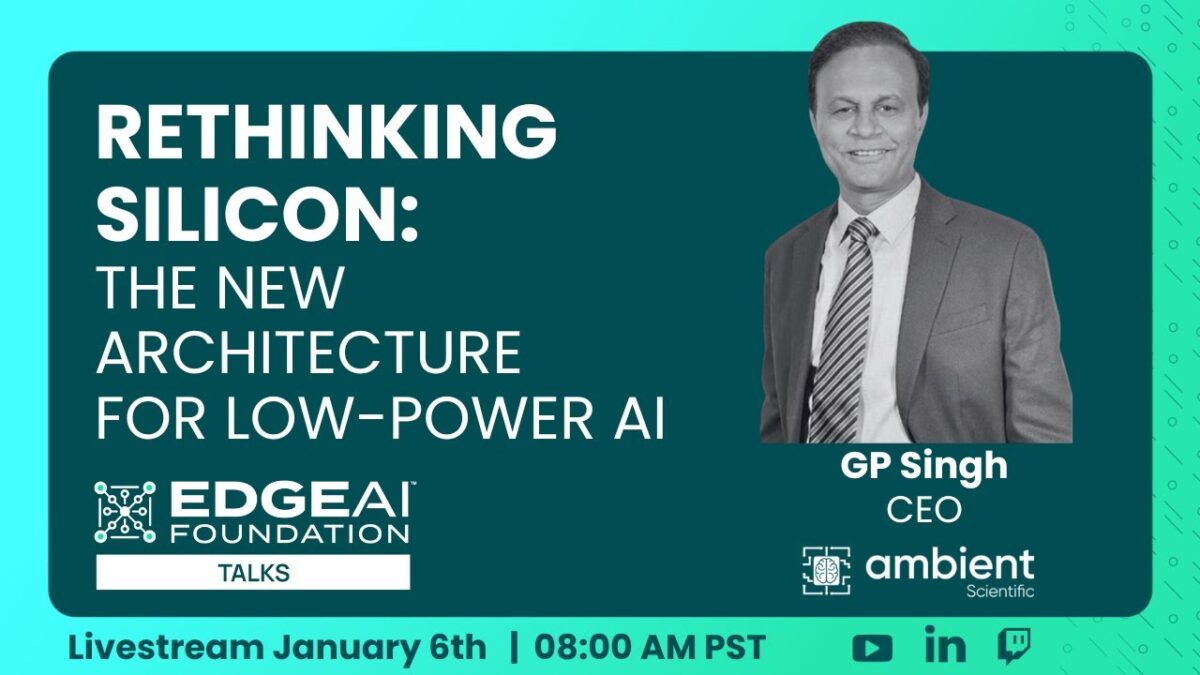
AI is not just another workload, it breaks the assumptions underlying classic compute. Moving data back and forth between memory and ALUs burns power faster than edge devices can supply. This podcast unpacks why low-power AI requires an entirely new silicon paradigm and how reengineering compute around data locality, in-memory operations, and an analog hybrid architecture unlocks intelligence everywhere.
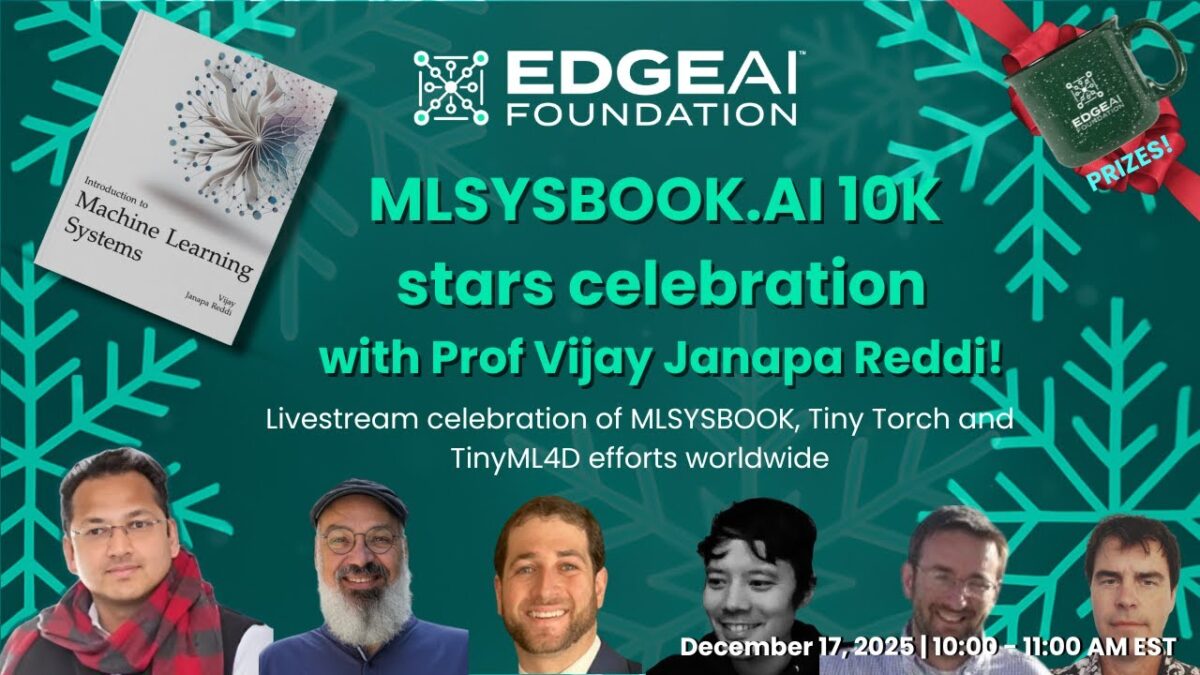
Join co-hosts Pete Bernard and Ed Doran for an electrifying celebration of MLSYSBOOK.AI hitting 10,000 stars!
Professor Vijay Janapa Reddi is our special guest for this milestone event featuring 2025’s breakthrough achievements in TinyML4D education, global workshops, and hands-on learning kits.
Discover what’s next: the revolutionary Tiny Torch launch, ambitious plans to reach 1 million learners worldwide, and exciting 2026 kit developments.
We’ll also dig into the new Edge AI Fundamentals Certification Badge program!
Cap it off with an exclusive AMA with Professor Reddi, diving into potential learner certifications and more. Whether you’re an edge AI enthusiast, educator, or practitioner, this celebration promises inspiring insights into democratizing edge AI education globally!
The Edge AI Revolution is Here
The cloud’s dominance is being challenged—and the Generative Edge AI community is leading the charge.
Across three groundbreaking EDGE AI FOUNDATION forums, we’ve witnessed a seismic shift: the cloud must evolve beyond its role as a centralized AI powerhouse. After years of fixed-function AI investments at the edge, a new era of practical innovation is exploding into the gap—and it’s happening faster than anyone predicted.
Tune in to hear these breakthrough thought leaders:
The cloud’s dominance is being challenged—and the Generative Edge AI community is leading the charge.
Across three groundbreaking EDGE AI FOUNDATION forums, we’ve witnessed a seismic shift: the cloud must evolve beyond its role as a centralized AI powerhouse. After years of fixed-function AI investments at the edge, a new era of practical innovation is exploding into the gap—and it’s happening faster than anyone predicted.
Tune in to hear these breakthrough thought leaders:
Day 2 — Sensing, Applications & Platforms (8:00–12:10 PT)
08:00–08:05 Welcome (organizers)
08:05–08:20 Fireside chat – Generative Edge AI in Automotive – Marin Kellner (McKinsey) / Pete Bernard (EDGE AI FOUNDATION)
Session 4 — Sensing, Interaction & Health
08:20–08:40 Michele Magno (ETH Zurich) — GenAI at the Edge: Wearables→AVs
08:40–09:00 Xiaofeng Tan (Pison) — Multimodal Hand Gesture Modeling
09:00–09:20 Ritik Shrivastava (Brainchip) — aTENNUate: Real-Time Audio Denoising
09:20–09:40 Luigi Occhipinti (Cambridge) — Artificial Sensor Intelligence & Health
09:40–10:00 Giovanni Scapellato (STMicroelectronics) — GenAI for Biosensors/Cardio
Session 5 — Endpoints, Industrial & Ecosystems
10:05–10:25 Davis Sawyer (NXP) — Industrial Edge: Old Meets New
10:25–10:45 Henrik Flodell (Alif Semiconductor) — GenAI at the Edge for Endpoints
10:45–11:05 David Cuartielles (Arduino) — Proposal of workflow and software architecture for the development of complex EdgeAI applications
11:05–11:25 Zechun Liu (META) — Advancing Large Language Models in Resource-Constrained Environments
11:25-11:45 Roberto Morabito (EURECOM) — Four Forums Later: How Generative AI at the Edge Has Evolved and Keeps Evolving
11:45–11:55 Closing (organizers)
This is the future of AI—decentralized, efficient, and unstoppable. The question isn’t whether to tune in. It’s whether you can afford to miss it.
This is the future of AI—decentralized, efficient, and unstoppable. The question isn’t whether to tune in. It’s whether you can afford to miss it.
The Edge AI Revolution is Here
The cloud’s dominance is being challenged—and the Generative Edge AI community is leading the charge.
Across three groundbreaking EDGE AI FOUNDATION forums, we’ve witnessed a seismic shift: the cloud must evolve beyond its role as a centralized AI powerhouse. After years of fixed-function AI investments at the edge, a new era of practical innovation is exploding into the gap—and it’s happening faster than anyone predicted.
Tune in to hear these breakthrough thought leaders:
Day 1 — Agentic Systems, Optimization & Toolchains
08:00–08:05 Welcome (organizers)
08:05–08:20 Fireside chat – Generative Edge AI in Industry – Rob Tiffany (IDC) / Pete Bernard (EDGE AI FOUNDATION)
Session 1 — Optimization & Co-Design for Efficient Edge GenAI
08:20–08:40 Thomas Ziereis (Roofline AI) — Compiling & Running SLMs on Edge
08:40–09:00 José Cano (University of Glasgow) — Accelerating LLMs at the Edge (HW–SW Co-Design)
09:00–09:20 Tinoosh Mohsenin (John Hopkins University) — E2EdgeGenAI
09:20–09:40 Andrea Basso (MITO Technology) — Small LMs on Resource-Constrained Platforms
Session 2 — Agentic & Distributed Edge Systems
09:45–10:05 SiYoung Jang (Nokia Bell Labs) — Distributed SLM-based Agentic AI for the Edge
10:05–10:25 Marcus Rueb (EnBW) — Agent Systems on the Edge 10:35–10:55 Pratik Sharda (CraftifAI) — Agentic AI in Action
1025-10:45 Pratik Sharda (CraftifAI) — Agentic AI in Action
Session 3 — Foundations & Toolchains
10:50–11:10 Mathias Lechner (LiquidAI) — LFM2: Designing the next-generation foundation model architecture for edge AI
11:10–11:30 Parmeet Kohli (Qualcomm) — Backbone Toolchains for GenAI 11:40–12:05
11:30–11:50 Ashutosh Kumar (Intel) — Edge AI Suites
11:50–12:10 IBM
12:10–12:15 Closing (organizers)
This is the future of AI—decentralized, efficient, and unstoppable. The question isn’t whether to tune in. It’s whether you can afford to miss it.