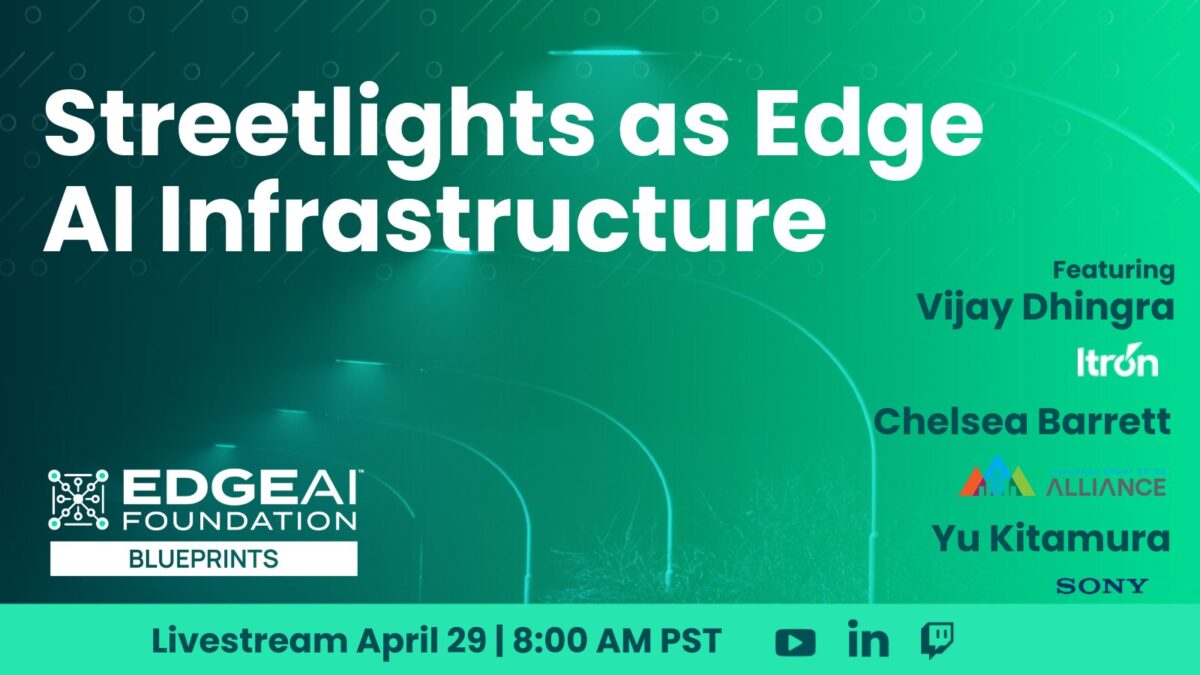
EDGE AI Blueprints: Streetlights as Edge AI Infrastructure

Join us for an insightful livestream exploring the intersection of edge AI and smart city infrastructure featuring three expert discussions:

1. Leveraging Streetlights as Edge AI Infrastructure
Brian Macias (Senior Engineer, San Jose) and Vijay Dhingra (Product Manager, Itron) will discuss how network-connected LED streetlights can serve as the perfect platform for edge AI sensor deployment. Learn how this approach simplifies installation, reduces costs, and solves common outdoor deployment challenges like power sources and connectivity.

2. Colorado Smart City Alliance Challenge Program 2025
Chelsea Barrett (Marketing & Program Director, Colorado Smart Cities Alliance) introduces the innovative C² Challenge program for 2025. Discover how this unique government procurement process eliminates rigid requirements, enabling businesses and academics to propose creative solutions to community problems. Learn about participation opportunities, timelines, and how urban and rural communities can benefit.

3. Sony’s AI Camera Developer Kit for Colorado Challenge
Yu Kitamura (Sr. Business Development Manager, Sony) showcases Sony’s edge AI vision systems and compatible developer kit specifically designed for Colorado Challenge Program applicants. Explore how these cutting-edge vision systems can power a variety of smart city applications.
Join us to discover how these technologies are transforming urban spaces and opening new opportunities for innovation!

EDGE AI Experts Reveal Pedestrian Tragedy Prevention Secrets

BLUEPRINTS: Building edge AI solutions in the real world

In this installment of the BLUEPRINTS series, we will look at “meta-blueprints,” or Blueprints, for Blueprints!

This unique show with embedUR, the creators of the ModelNova platform, will show attendees a framework for creating Edge AI solutions to solve real-world problems. The intuitive and capable ModelNova platform demonstrates a pathway for companies looking to develop end-to-end solution frameworks ranging from automotive, manufacturing, smart home, and more.

EDGE AI BLUEPRINTS: HARNESSING EDGE AI TO MAP PLASTIC DEBRIS IN THE WORLD’S OCEANS

The world’s oceans are burdened with unnecessary plastic waste, with estimates of between 75 and 199 million tons [68 – 188M tonnes] already polluting marine ecosystems today. And to make things worse, without intervention, plastic waste entering aquatic environments could nearly triple—from 9–14 million tonnes per year in 2016 to a projected 23–37 million tonnes per year by 2040.

The Ocean Cleanup, a nonprofit foundation dedicated to ridding the oceans of plastic, is leveraging AI-powered computer vision to enhance debris detection, modelling, and collection. But deploying and scaling intelligence at the edge presents unique challenges—how do you train and deploy an AI model, process real-time data on moving vessels, in extreme environmental conditions, with limited connectivity and power constraints?

This Blueprint presentation showcases the collaboration between Au-Zone and The Ocean Cleanup to develop and deploy an edge-optimized AI pipeline for The Ocean Cleanup’s Automated Ocean Debris Imaging System (ADIS). We will discuss the challenges and break down the development of an embedded machine learning model for real-time plastic density monitoring—from data collection and model optimization to deployments and scaling up.

Attendees will gain insights into how the system was developed and how the data collected will be used to improve modelling of the marine systems to further optimize recovery of the debris. Join us for this presentation on AI for good, as we chart a course for scalable, AI-driven ocean conservation—transforming innovation into real-world impact.

EDGE AI BLUEPRINTS: SMARTER FISH COUNTING WITH AI AGENTS AT THE EDGE

Aizip’s and SoftBank’s Watatumi: AI-powered Smart Fish Farm Software Suite has been recognized as a CES 2025 Innovation Awards Honoree!

Developed in collaboration with SoftBank, our solution revolutionizes fish farming with advanced AI-driven capabilities that enhance operational efficiency and profitability. The software suite performs critical activities like feeding management, cage monitoring, and fish counting and size estimation through its suite of intelligent features.

Efficient neural network architectures run directly on embedded chipsets attached to enclosures, eliminating the need to transmit large video data and ensuring cost efficiency, reliability, and simplified integration.

Watatumi’s models are engineered to perform consistently across diverse conditions—handling variations in lighting, water clarity, and weather. The solution adapts seamlessly to different camera setups, offering unparalleled flexibility and accuracy.

EDGE AI TALKS! MLSysBook.Al: Essentials of Engineering ML Systems with Vijay Janapa Reddi

EDGE AI TALKS: SNIPESEARCH: USING AGENTIC AI TO EMPOWER WITH KNOWLEDGE

SnipeSearch is an advanced search tool designed for precision and reliability, leveraging a swarm of specialized agents that function like OSINT detectives to deliver highly targeted results.

These agents include the Academic Agent, Video Agent, Image Agent, and a general Web Agent. With customization options, it can restrict searches to authoritative sources, ensuring the most relevant and focused outcomes. A built-in fact-checking layer further enhances trust by verifying the accuracy and compliance of the information, making SnipeSearch an indispensable tool for anyone seeking precise, reliable results across academic papers, videos, or web content.

EDGE AI TALKS: AUDIO APPLICATIONS IN THE TINYML ERA

The rapid evolution of TinyML has opened up new frontiers in the deployment of AI models on microcontroller units (MCUs), enabling sophisticated functionality in devices with extremely limited computational resources. This development is particularly transformative for audio-based applications, where balancing performance and efficiency is paramount.

In this presentation, we introduce two key audio use cases that leverage TinyML. First, we explore single-channel environmental noise cancellation (ENC) – a critical technique for improving human-to-human communication by isolating speech from background noise and enhancing human-to-machine interactions by reducing transcription errors. Second, we present
open vocabulary keyword spotting – referred to as text2model (T2M) – an innovative approach that allows users to define custom commands on the fly without the need for extensive data
collection or labeling.

We then discuss practical strategies for running these models efficiently on MCUs, including quantization-aware training (QAT), single value decomposition (SVD) compression, and distillation. Real-world challenges are also addressed, such as converting models from PyTorch to TensorFlow Lite (TFLite) and handling streaming in convolutional neural network (CNN) layers.

By the end of this session, you will gain a concise overview of how these audio applications can be implemented on resource-constrained devices, along with insights into the practical
challenges of bridging the gap from research to real-world deployment.

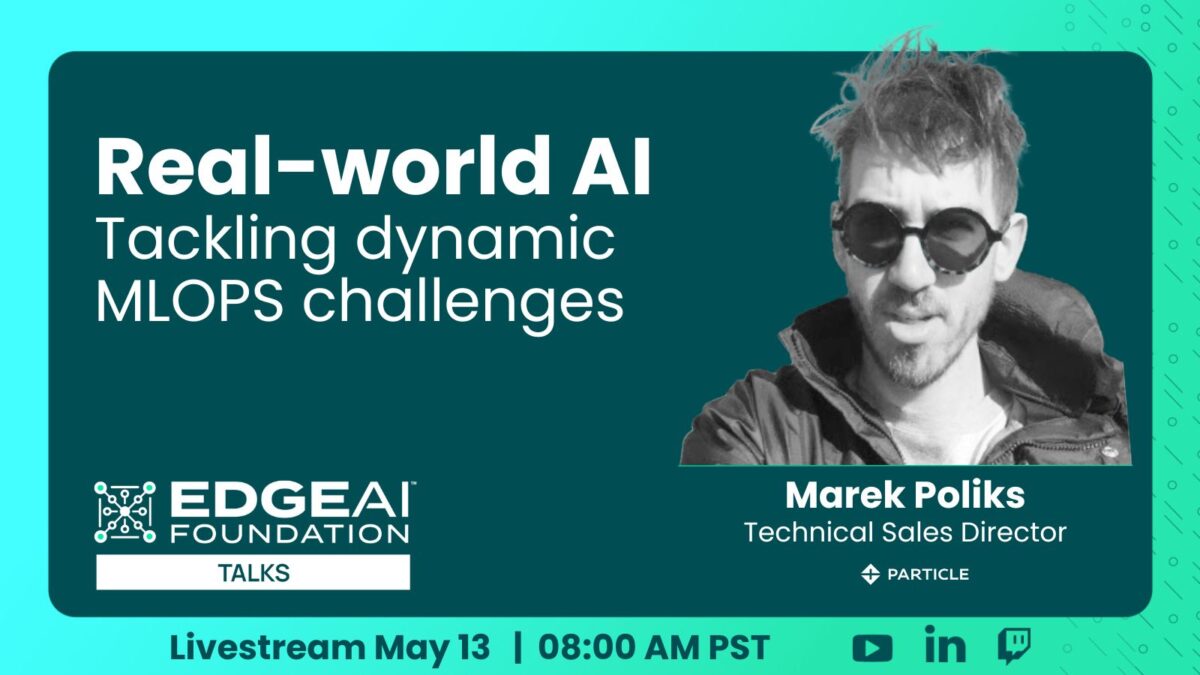
EDGE AI TALKS: REAL WORLD AI: TACKLING DYNAMIC MLOPS CHALLENGES

Edge AI devices are often differently intelligent than cloud-based AI solutions. As AI moves to the edge, deploying and updating both firmware and ML models across remote, cellular-connected devices poses unique opportunities for new types of intelligences coupled to more dynamic MLOps and CI/CD architectures. This talk examines how integrated platforms for data, connectivity, and over-the-air software delivery solve meaningfully new real-world problems.

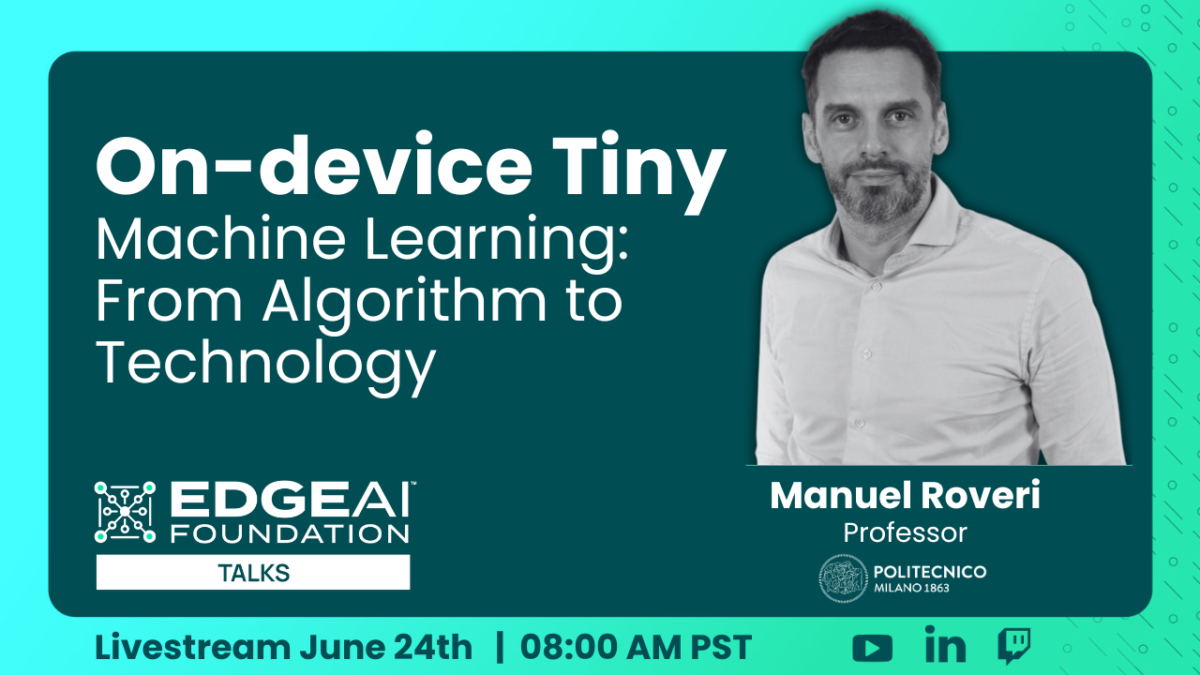
EDGE AI TALKS: ON-DEVICE TINY MACHINE LEARNING: FROM ALGORITHM TO TECHNOLOGY

What if the devices around us could not only make intelligent decisions but also learn and evolve on their own?

As computing becomes ubiquitous, the “computing everywhere” paradigm is reshaping how intelligence is embedded into everyday devices. This talk will deepen the transformative potential of this shift in driving the widespread adoption of Tiny Machine Learning (TinyML) in daily life.

Going beyond traditional inference-only approaches, this talk will explore the challenges and opportunities of on-device learning in tinyML, addressing the constraints of memory, computation, and energy efficiency. The discussion will highlight adaptive mechanisms to optimize processing pipelines dynamically during inference, as well as lightweight and efficient on-device training strategies that enable continuous adaptation, personalization, and responsiveness to evolving environmental conditions.